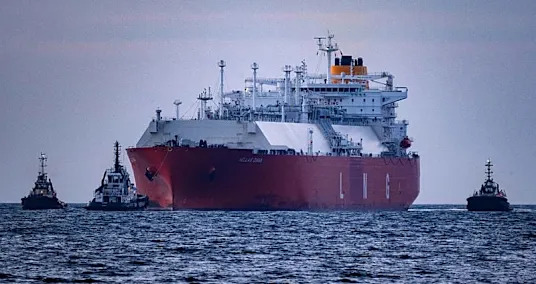
Germany has begun receiving its first-ever liquefied natural gas deliveries from Oman, even as war in the Middle East chokes global supply routes — but a deeper look at the country's gas supply chain suggests Berlin may be more exposed to the crisis than official figures let on.
The shipments, delivered under a four-year contract signed in 2023 between Oman's state LNG producer and German gas importer Securing Energy for Europe (SEFE), began as planned this month, a SEFE spokesperson told the German Capital magazine.
Oman sits on the far side of the Strait of Hormuz from Iran, and the company said deliveries are unaffected by the ongoing conflict.
The news offers a rare bright spot in an otherwise tightening energy picture.
Iran's blockade of the strait has halted all LNG exports from Qatar, the world's second-largest LNG exporter, while an Iranian strike on Qatar's Ras Laffan production facilities in mid-March knocked out 17% of the Gulf state's output capacity.
QatarEnergy chief executive Saad al-Kaabi said repairs will take three to five years.
The company has since invoked force majeure on several long-term contracts, with customers in China, South Korea, Italy, and Belgium among those affected.
Economics Minister Katherina Reiche has sought to play down the risks, saying Germany receives "no significant quantities" of LNG from the Gulf and that 90% of its gas arrives via pipeline from Norway, the Netherlands, and Belgium.
Germany more exposed than expected?
Those figures are technically accurate — but they obscure a more complex picture, according to Capital.
Only 10.3% of Germany's gas imports arrived via its own four LNG terminals last year, all of it almost entirely from the US.
However, the Netherlands and Belgium, which together supplied 45% of Germany's total gas imports in 2025, are themselves among the EU's largest LNG importers.
Rotterdam and Zeebrugge receive large volumes of liquefied gas by tanker, regasify it, and pipe it onward into Germany.
Belgium's Zeebrugge terminal handled a record 55.5 terawatt-hours of LNG in 2025, double its previous record.
The Netherlands sourced 45% of its total gas imports as LNG in 2024, with American cargoes accounting for 30% alone, Capital reports.
Because the origin of individual gas molecules moving through pipelines cannot be traced, the true scale of Germany's indirect LNG dependency — and its indirect exposure to US supply — is impossible to pin down precisely. But the direction of travel is clear.
Germany's storage levels add to the pressure. Reserves currently stand at around 22%, historically low for this point in the year, according to Capital.
LATEST POSTS
- 1
 IDF destroys Hamas shaft in northern Gaza with loaded 'ready to fire' rocket aimed at Sderot
- 2Toilet rats? Washington health officials warn of possible rodents in sewer systems after floods
- 3SpaceX shatters its rocket launch record yet again — 165 orbital flights in 2025
- 4A top Marine shares his secrets to keeping fit at 50
- 5Instructions to Utilize the Towing Highlights of the Slam 1500 Productively.


- China bans storing cremated remains in empty 'bone ash apartments'
- Tuesday, April 7. Russia’s War On Ukraine: News And Information From Ukraine
- 10 Demonstrated Tips to Dominate Video Altering on Your Cell phone in 2023
- Very good quality Greens All over The Planet
- Journalist reported killed in the Gaza Strip
- Hyundai Is Keeping the i30 Alive While America Keeps Losing Cars Like It
- US measles cases surpass 2,000, highest in 30 years: CDC
- Vote in favor of your Favored kind of craftsmanship
- Before trips to Mars, we need better protection from cosmic rays