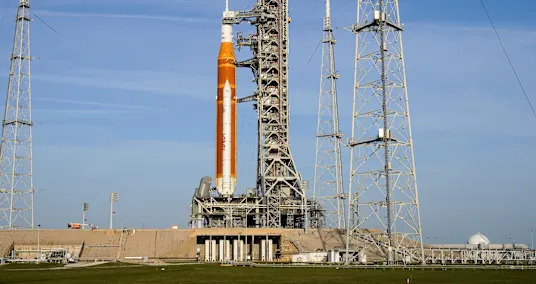
CAPE CANAVERAL, Fla. (AP) — After weeks of fuel leaks and other issues, NASA faced a trouble-free countdown Tuesday on the eve of astronauts' first trip to the moon in more than half a century.
Officials reported the moon rocket was doing well on the pad, and the weather looked promising. Forecasters put the odds of favorable conditions at 80%.
“Everybody's pretty excited and understands the significance of this launch,” said senior test director Jeff Spaulding.
The four astronauts assigned to the Artemis II mission will become the first lunar visitors since Apollo 17 in 1972. They’ll zip around the moon without landing or even orbiting, and come straight back.
It's the closest NASA has come to launching Artemis II. Hydrogen fuel leaks bumped the flight from February to March, then clogged helium lines pushed it to April. The space agency has only a handful of days every month to send the three Americans and one Canadian to the moon.
Confident that all of these problems are fixed, the launch team plans to begin fueling the 32-story Space Launch System rocket on Wednesday morning for an evening send-off.
___
The Associated Press Health and Science Department receives support from the Howard Hughes Medical Institute’s Department of Science Education and the Robert Wood Johnson Foundation. The AP is solely responsible for all content.
LATEST POSTS
- 1
 Lego's $650 Pokémon set is already sold out as demand, preorders surge
- 2Alice Wong, founder of the Disability Visibility Project, dies at 51
- 3Heat Wave Fuels Massive Wildfire In Australia
- 4New COVID-19 variant 'Cicada' is spreading. What to know about BA.3.2.
- 5Big Bear glows with big stars | Space photo of the day for Dec. 31, 2025



- 10 Delectable Specialty Mixed drinks
- People can't get enough of this couple's Hallmark movie reviews. They don't know the painful backstory.
- Israel, Gulf states report fresh missile and drone attacks
- German petrol stations hike prices as once-a-day rule takes effect
- What's your #1 tone
- Flu season is ramping up, and some experts are "pretty worried"
- Energy security rifts widen in Europe
- Lightning on Jupiter could be up to 1 million times stronger than on Earth
- Warship sunk by British fleet, remains of sailor found after 225 years